click to enlarge

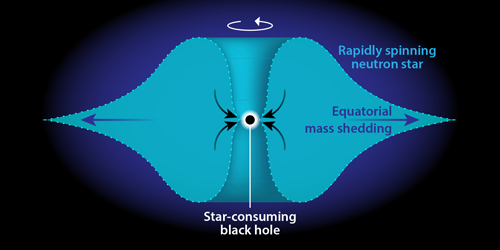
(drawing by E. Kirich)

 Alexander Kusenko

Professor of Physics and Astronomy

Office: 4-915, PAB (click to see the map)
Phone: +1 310 825 4814

My public key


My calendar (free/busy times)


List of publications from SPIRES or ADS


This research is supported by
U.S. Department of Energy
NASA

Seminars this week
Physics & Astronomy Colloquium
TEP seminars


TEP group
Particle Astrophysics
Physics and Astronomy at UCLA
Directions to UCLA


any_browser Valid HTML 4.01 Transitional

Theoretical Elementary Particle Physics and Astrophysics

Ultrahigh-energy cosmic rays[1] present a puzzle. It is difficult to understand why a single cosmic particle should carry as much energy as a bullet! The origin of these extreme cosmic rays remains unclear.  In addition, interactions with the cosmic microwave background should have prevented the most energetic particles from reaching us. The resolution of this puzzle may teach us about physics beyond the Standard Model.
Ultrahigh-energy cosmic neutrinos can help understand the physics of particle interactions at energies well beyond the reach of terrestrial accelerators[2].  Read about this in Nature science update  and in  AIP Physics News Update.

Q-balls are non-topological solitons that owe their stability to a conservation of some global charge. Baryonic Q-balls appear in every supersymmetric extension of the Standard Model [3]. If supersymmetry exists, stable Q-balls could be copiously produced at the end of inflation and may  now exist as a form of dark matter [4]. Experimental search for relic Q-balls is under way[5]. Read a New Scientist article and also a story in AIP Physics News Update.

Pulsar velocities and dark matter.  Pulsar velocities (100 to 1600 km/s) present an outstanding puzzle in astrophysics. Pulsars are magnetized rotating neutron stars, which are born in supernova explosions of ordinary stars. Most of the energy released in the explosions, 1053 erg, is carried away by neutrinos. A 1% asymmetry in the distribution of these neutrinos can give the nascent pulsar a kick powerful enough to explain the observed velocities of pulsars. We showed that such an asymmetry could result from neutrino conversions in the hot magnetized nuclear matter of a cooling neutron star [6]. In the event of a nearby supernova, one may be able to observe gravity waves from a pulsar acelerated by the neutrino emission [7]. It intriguing that the same sterile neutrino needed to explain the pulsar kicks can make up the dark matter in the universe.   Sterile neutrinos can also play a role in the formation of the first stars [8], and they may open a window on the new physics at the electroweak scale [9].  Read about sterile neutrinos, dark matter, and the pulsar kicks:  Nature (2006)Economist (2006),  New Scientist (2006)CERN Courier (2006) AIP Physics News Update, New Scientist (1996), Sky and Telescope (1997).  

BaryogenesisAlthough every particle has its antiparticle, there is no antimatter in the observed universe. The process in which the  matter-antimatter asymmetry was produced in the early universe, called  baryogenesis[10], remains a mystery.    We showed that the baryon asymetry could have arisen from standard electroweak interactions at the end of inflation[11].  Another appealing scenario is Affleck-Dine baryogenesis, which can generate both ordinary matter and dark matter [10].

Selected Recent Publications:
1. G.Gelmini and A.Kusenko, Phys.Rev.Lett. 82:5202,1999
G.Gelmini and A. Kusenko, Phys.Rev.Lett.84:1378,2000


2. A.Kusenko and T.Weiler, Phys.Rev.Lett.88:161101,2002

3.A. Kusenko, Phys.Lett.B405:108,1997

4. A. Kusenko and M. Shaposhnikov, Phys.Lett.B418:46,1997

5. A. Kusenko et al., Phys.Rev.Lett. 80:3185,1998
A.Kusenko and P. Steinhardt,  Phys.Rev.Lett. 87:141301,2001
G.Gelimini,A. Kusenko, and Nussinov, Phys.Rev.Lett. 89:101302,2002 

6. A.Kusenko and G.Segrè, Phys.Rev.Lett. 77:4872,1996;
Phys.Lett.B396:197,1997; Phys.Rev.Lett. 79:2751,1997; Phys.Rev.D 59:061302,1999;  G. Fuller, A. Kusenko, I.Mocioiu, S.Pascoli, Phys.Rev. D68:103002 (2003); C. Fryer and A. Kusenko, ApJ.S 163:335,2006.

7. L.C. Loveridge, Phys. Rev. D69, 024008 (2004).
8. P. Biermann and A. Kusenko, Phys.Rev.Lett. 96, 091301 (2006); J.Stasielak, P. Biermann, and A. Kusenko, ApJ 654, 290 (2007).

9. A. Kusenko, Phys. Rev. Lett. 97, 241301 (2006).

10. M. Dine and A. Kusenko, Rev.Mod.Phys.76:1 (2004)

11. J.Garcia-Bellido, D.Grigorev, A.Kusenko, M.Shaposhnikov, Phys. Rev. D60,123504(1999); J.M.Cornwall and A.Kusenko, Phys. Rev. D61, 103510 (2000); J.M.Cornwall, D.Grigoriev, and A.Kusenko, Phys.Rev.D64:123518,2001

List of publications from SPIRES