
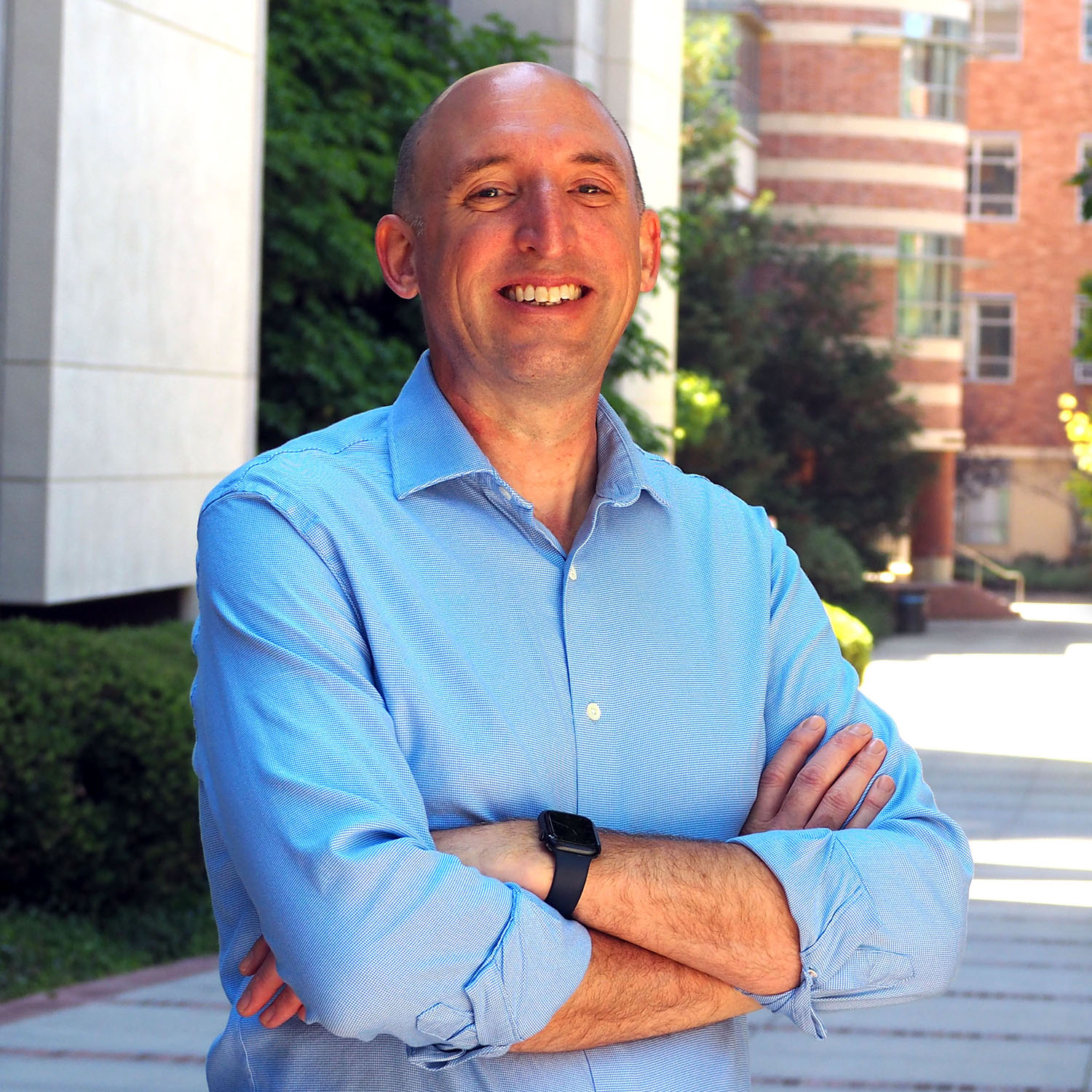
in Nice, France

Troy Carter

Associate Professor of Physics
Dept. of Physics and Astronomy, UCLA
Box 951547, 4-714 Phys & Astro Building
Los Angeles, CA 90095-1547
(310) 825-4770 (office)
(310) 825-4057 (fax)
(310) 825-0957 (lab office, 15-70G Rehab)
(310) 206-5484 (fax (Rehab))
tcarter@physics.ucla.edu


My CV (PDF)

Educational Background

Ph.D., Astrophysical Sciences (plasma physics), Princeton University (2001)
B.S., Physics and Nuclear Engineering, North Carolina State University (1995)

Teaching

  • 2007-2008: Winter: Physics 180E (Plasma Lab), Spring: Physics 6A (Physics for Life Science Majors)
  • 2006-2007: Winter: Physics 180E (Plasma Lab), Spring: Physics 110A (E&M)
  • 2005-2006: Fall: Physics 110B (E&M), Spring: Physics 6C (Physics for Life Science Majors)
  • 2004-2005: Fall: Physics M122 (Plasma Physics), Spring: Physics 110A (E&M)
  • 2003-2004: Winter: Physics 110A (E&M), Spring: Physics 110B (E&M)
  • 2002-2003: Fall: Physics 1B (Intro Physics), Spring: Physics 1B (Intro Physics)
  • Some more info on my teaching methods: Eric Mazur's site on peer instruction.
Current graduate students:
Dave Auerbach, Jon Hillesheim, David Pace, Anne White, Travis Yates

Former graduate students:
Brian Brugman (2007, AllianceBernstein)

Current undergraduate students:
Matt Levy, Aaron Senter

Group Picture (2007, from left): Doug Martinez (HS Teacher), Caroline Tran (HS Teacher), me, Anne White, Matt Levy, Johann Justiniano (REU summer '07), David Pace, Jon Hillesheim, Sean Kepple (HS Teacher)

Research Interests

My research involves experiments in laboratory plasmas and seeks to understand phenomena relevant to magnetic confinement fusion energy and to space and astrophysical plasmas. In particular my work focuses on nonlinear wave interactions, turbulence, and turbulence-induced transport in magnetized plasmas. I am a member of the Center for Multiscale Plasma Dynamics (CMPD), which is a DOE Fusion Science Center led by UCLA and University of Maryland.
Intermittent turbulence and turbulent structures:
Intermittent turbulence, or turbulence that is "bursty" in time or "patchy" in space, is observed in the edge of almost all magnetic confinement laboratory devices. In these devices, the intermittency is the result of the generation and convective transport of coherent filamentary structures (often called "blobs" or "holes"). The convection of these structures significantly enhances cross-field particle transport and may play a role in the poorly understood Greenwald density limit in tokamaks. I have been studying intermittent turbulence and turbulent structures in the Large Plasma Device (LAPD) at UCLA. The figure to the left shows two-dimensional cross-correlation images of the density and potential of turbulently generated structures in LAPD. The images show that the blobs are localized filamentary structures with a dipolar potential while the holes are part of a more extended turbulent structure (T.A. Carter, Phys. Plasmas 13, 010701 (2006)). Future work will focus on the mechanism by which the structures are generated, in particular exploring the role of sheared cross-field flows (in collaboration with Prof. Mark Gilmore (UNM)).
Nonlinear interactions between Alfvén waves:


Movie of cross-field structure of interacting waves (driven m=0 ("lower") and m=1 ("center") waves along with upper sideband and density fluctuation).
Magnetohydrodynamic (MHD) turbulence has been invoked to explain the measured spectrum of magnetic fluctuations in the solar wind, turbulence in the interstellar medium (which causes scintillations in radio astronomy), and angular momentum transport and heating in accretion disks. In the ideal, incompressible MHD model, interactions between counter-propagating Alfvén waves are responsible for the turbulent energy cascade. Motivated by this picture, we are studying interactions between Alfvén waves in LAPD (Graduate student: Brian Brugman, work in collaboration with Dr. Patrick Pribyl; theory collaboration with Prof. Steven Cowley and members of the CMPD). We generate large amplitude waves using a resonant cavity (the Alfvén wave maser) or using antennas and novel broadband, high-power drivers. Alfvén waves in LAPD (and near the dissipation scale in astrophysical plasmas) are dispersive kinetic or inertial Alfvén waves. We have conducted experiments in which two co-propagating Alfvén waves beat together due to dispersion (which allows waves with differing frequency to pass through one another). The beat wave drives a density fluctuation (a nonlinear pseudo mode) which in turn scatters the Alfvén waves, creating a series of sidebands (T.A. Carter, B. Brugman, P. Pribyl, W. Lybarger, Phys. Rev. Lett. 96, 155001, (2006).). A related project is being carried out on the Madison Symmetric Torus (MST) at U. Wisconsin (Graduate student: Travis Yates, work in collaboration with Dr. David Brower, Dr. Weixing Ding, and the MST team). There faraday rotation measurements using an FIR laser are being used to study broadband magnetic fluctuations, which may be the result of a turbulent cascade driven by tearing modes but could also be driven by shear flow or by density gradients in MST (drift-Alfvén waves).
Suppression of turbulent transport by sheared flow:


Movie of the 2D cross-correlation (still frame above). Time in the movie is correlation delay.
The high-confinement mode or H-mode is an important regime in tokamaks where turbulent transport is suppressed in a region where strong shear flows exist (the transport barrier). An often used qualitative explanation of turbulence suppression is that the sheared flow "rips apart" turbulent eddies, creating smaller eddies which are less efficient at transport. Theoretically, shear flow is predicted to cause radial decorrelation (rip apart eddies), reduce turbulent amplitude, and modify the cross-phase between fluctuating density and electric field. We have driven sheared flow in the edge of LAPD through biasing (in collaboration with Dr. James Maggs, David Pace, and Dr. Robert Taylor). If the applied bias exceeds a threshold, dramatic steepening of the edge density profile is observed indicating suppression of turbulent transport. Detailed measurements of the turbulence in the edge show that while the amplitude is reduced, the primary cause of the transport suppression is modification of the cross-phase. Two-dimensional cross-correlation measurements show that while the correlation function is stretched azimuthally in the presence of the shear flow, the radial correlation length is not significantly altered (see figure on left) (T.A Carter, J.E. Maggs, and D.C. Pace, Euro. Conf. Abs., 29C, O-4.017 (2005)).
Turbulence and transport driven by temperature gradients:
Heat transport in tokamaks (such as DIII-D on the left) is thought to be controlled by turbulence associated with radial gradients in electron and ion temperature. We are preparing to make electron temperature fluctuation measurements on DIII-D using an electron cyclotron emission (ECE) radiometer (Graduate student: Anne White, in collaboration with Dr. Tony Peebles and Dr. Lothar Schmitz). Temperature fluctuation measurements will be made using a correlation technique, where fluctuations in two closely spaced frequency ranges (and therefore in two closely spaced positions in the plasma) are correlated to determine the temperature fluctuation spectrum. We will explore temperature fluctuations in broadband turbulence in the core of DIII-D as well those arising due to Alfvén Eigenmodes and Neoclassical Tearing Modes. We are also exploring instabilities, turbulence, and heat transport associated with filamentary temperature structure in LAPD (Graduate student: David Pace, in collaboration with Prof. George Morales and Dr. James Maggs). This work will extend earlier work led by Prof. Morales, Dr. Maggs and their students. In particular, we are focusing on the transition from coherent drift-Alfvén waves to turbulence, on the role of flow, and on intermittent temperature fluctuations.
For information on other plasma physics research activities at UCLA, visit the Plasma Science and Technology Institute website.

Publications

  1. A. E. White, L. Schmitz, G. R. McKee, C. Holland, W. A. Peebles, T. A. Carter, M. W. Shafer, M. E. Austin, K. H. Burrell, J. Candy, J. C. DeBoo, E. J. Doyle, M. A. Makowski, R. Prater, T. L. Rhodes, G. M. Staebler, G. R. Tynan, R. E. Waltz, and G. Wang, "Measurements of core electron temperature and density fluctuations in DIII-D and comparison to nonlinear gyrokinetic simulations," Phys. Plasmas 15, 015166 (2008). (doi:10.1063/1.2895408)
  2. L. Schmitz, A.E. White, T.A. Carter, W.A. Peebles, T.L. Rhodes, K.H. Burrell, W. Solomon, and G.M. Staebler, "Observation of Reduced Electron-Temperature Fluctuations in the Core of H-Mode Plasmas," Phys. Rev. Lett. 100, 035002 (2008). (doi:10.1103/PhysRevLett.100.035002).
  3. Yang Zhang, W. W. Heidbrink, H. Boehmer, R. McWilliams, Guangye Chen, B. N. Breizman, S. Vincena, T. Carter, D. Leneman, W. Gekelman, P. Pribyl, and B. Brugman, "Spectral gap of shear Alfven waves in a periodic array of magnetic mirrors," Phys. Plasmas 15, 012103 (2008). (doi:10.1063/1.2827518).
  4. J.E. Maggs, T.A. Carter, and R.J. Taylor, "Transition from Bohm to classical diffusion due to edge rotation of a cylindrical plasma," Phys. Plasmas 14, 052507 (2007). (doi:10.1063/1.2722302).
  5. A.E. White, S.J. Zweben, M.J. Burin, T. A. Carter, T.S. Hahm, J.A. Krommes, and R.J. Maqueda, "Bispectral Analysis of Low- to High-confinement Mode Transitions in the National Spherical Torus Experiment," Phys. Plasmas 13, 072301 (2006). (doi:10.1063/1.2215439,PPPL-4178)
  6. J.C. Perez, W. Horton, R.D. Bengston, and T.A. Carter, "Study of strong cross-field sheared flow with the vorticity probe in the Large Plasma Device," Phys. Plasmas 13, 055701 (2006). (doi:10.1063/1.2179423)
  7. T.A. Carter, B. Brugman, P. Pribyl and W. Lybarger, "Laboratory observation of a nonlinear interaction between shear Alfvén waves," Phys. Rev. Lett. 96, 155001 (2006). (doi:10.1103/PhysRevLett.96.155001, physics/0509180)
  8. T.A. Carter, "Intermittent turbulence and turbulent structures in a linear magnetized plasma," Phys. Plasmas 13, 010701 (2006). (doi:10.1063/1.2158929, physics/0504209)
  9. R.J. Taylor, T.A. Carter, J.-L. Gauvreau, P.-A. Gourdain, A. Grossman, D.J. LaFonteese, D.C. Pace, L. Schmitz, A.E. White, and T.F. Yates, "Particle pinch mitigated by radial currents in the Electric Tokamak," Nucl. Fusion 45, 1634 (2005). (doi:10.1088/0029-5515/45/12/019).
  10. B. Van Compernolle, W. Gekelman, P. Pribyl, and T.A. Carter, "Generation of Alfvén waves by high power pulse at the electron plasma frequency," Geophys. Res. Lett. 32, L08101 (2005). (doi:10.1029/2004GL022185)
  11. J.E. Maggs, G.J. Morales, and T.A. Carter, "An Alfvén wave maser in the laboratory," Phys. Plasmas 12, art. no. 013103 (2005). (doi:10.1063/1.1823413)
  12. W. Horton, J.C. Perez, T.A. Carter, and R. Bengston, ``Vorticity probes and the characterization of the Kelvin-Helmholtz instability in the LArge Plasma Device (LAPD) experiment,'' Phys. Plasmas 12, art. no. 022303 (2005). (doi:10.1063/1.1830489)
  13. F. Trintchouk, M. Yamada, H. Ji, R. M. Kulsrud, and T. A. Carter, "Measurement of the transverse Spitzer resistivity during collisional magnetic reconnection," Phys. Plasmas 10, 319 (2003). (doi:10.1063/1.1528612)
  14. T. A. Carter, M. Yamada, H. Ji, R. M. Kulsrud, and F. Trintchouk, "Experimental study of lower-hybrid drift turbulence in a reconnecting current sheet," Phys. Plasmas 9, 3272 (2002). (doi:10.1063/1.1494433)
  15. T. A. Carter, H. Ji, F. Trintchouk, M. Yamada, and R. M. Kulsrud, "Measurement of lower-hybrid drift turbulence in a reconnecting current sheet," Phys. Rev. Lett. 88, 015001 (2002) (doi:10.1103/PhysRevLett.88.015001)
  16. T. A. Carter, "Experimental study of fluctuations in a reconnecting current sheet," Ph.D. Thesis, Princeton University (2001) (pdf)
  17. H. Ji, T. Carter, S. Hsu, and M. Yamada, "Study of local reconnection physics in a laboratory plasma," Earth Planets Space 53, 539 (2001) (pdf)
  18. S. C. Hsu, T. A. Carter, G. Fiksel, H. Ji, R. M. Kulsrud, and M. Yamada, "Experimental study of ion heating and acceleration during magnetic reconnection," Phys. Plasmas 8, 1916 (2001) (doi:10.1063/1.1356737)
  19. M. Yamada, H. Ji, S. Hsu, T. Carter, R. Kulsrud, and F. Trintchouk, "Experimental investigation of the neutral sheet profile during magnetic reconnection," Phys. Plasmas 7, 1781 (2000) (doi:10.1063/1.873999)
  20. S. C. Hsu, G. Fiksel, T. A. Carter, H. Ji, R. M. Kulsrud, and M. Yamada, "Local Measurement of Nonclassical Ion Heating during Magnetic Reconnection," Phys. Rev. Lett. 84, 3859 (2000) (doi:10.1103/PhysRevLett.84.3859)
  21. H. Ji, M. Yamada, S. Hsu, R. Kulsrud, T.Carter, and S. Zaharia "Magnetic reconnection with Sweet-Parker characteristics in two-dimensional laboratory plasmas," Phys. Plasmas 6, 1743 (1999). (doi:10.1063/1.873432)
  22. M. Yamada, H. Ji, S. Hsu, T. Carter, R. Kulsrud, Y. Ono, and F. Perkins, "Identification of Y-Shaped and O-Shaped Diffusion Regions During Magnetic Reconnection in a Laboratory Plasma," Phys. Rev. Lett. 78, 3117 (1997) (doi:10.1103/PhysRevLett.78.3117)
  23. M. Yamada, H. Ji, S. Hsu, T. Carter, R. Kulsrud, N. Bretz, F. Jobes, Y. Ono, and F. Perkins, "Study of driven magnetic reconnection in a laboratory plasma," Phys. Plasmas 4, 1936 (1997) (doi:10.1063/1.872336)