The research interests of the group focus on materials
where interactions between electrons, and electron-phonon interactions, often
in combination with disorder may lead to new type of electron liquid, electron
solid or electron glass states. The group explores the low energy
electrodynamics of such states in order to gain insight on the collective and
single particle charge excitations of such states. Electron solids Broken symmetry states, such as charge and spin
density waves, brought about by electron or electron-phonon interactions in
highly anisotropic metals. Electron liquids Nearly one dimensional metals and molecular nanowires
(strictly one-dimensional chains of atoms or atomic arrangements), where due
to the reduced dimensionality electron-electron interactions lead to a novel
quantum liquid state, called the Luttinger Liquid, and to Luttinger-Fermi Liquid
crossovers. Electron glasses Metals and doped semiconductors where the interplay
of interactions and disorder leads to metal-insulator Quantum Phase Transitions
(QPTs), to a quantum critical state and to a Fermi Glass state on the insulating
side of the transition. We use a variety of experimental techniques which examine
the electrodynamics of these states. In all cases, the relevant energy scales
where the unusual charge excitations occur are well below the single particle
energies of metals, typically of the order of 1eV. This then requires the exploration
of the electrodynamics well below the conventional optical spectral range. Therefore,
in pursuing our research goals summarized above the group has developed and
utilized a variety of highly sensitive measurement configurations in the radio
frequency, micro and millimeter wave spectral range.
The materials we investigate include:
1. ELECTRON SOLIDS - CHARGE AND SPIN DENSITY WAVES
Density waves are broken symmetry
states of metals, brought about by electron-phonon or by electron-electron
interactions. The ground states are the coherent superposition of electron-hole
pairs, and, as the name implies, the charge density or spin density
is not uniform but displays a periodic spatial variation. The former
is called the charge density wave (CDW), the latter the spin density
wave (SDW) state of metals. Charge density waves were first
discussed by Frölich in 1954 and by Peierls in 1955; spin density
wave states were postulated by Overhauser in 1962. It was recognized
early that highly anisotropic band structures are important in leading
to these ground states. Not surprisingly, experimental evidence for
these ground states was found much later, when materials with a linear
chain structure and metallic properties were discovered and investigated.
Several groups of both organic and inorganic materials are now standard
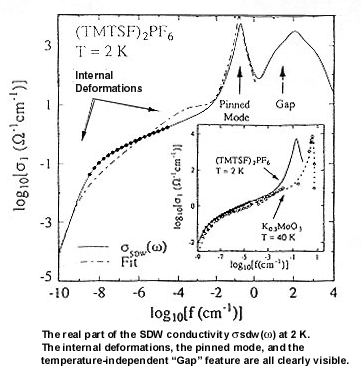
examples of density wave ground states. The group has identified various
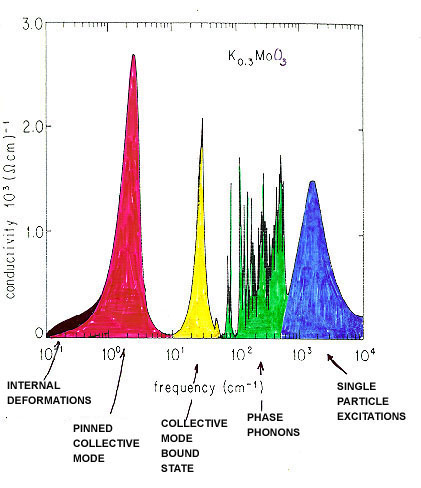
collective and single practice excitations of the ground states. Both
the so called pinned density wave nodes, the response due to the dynamics
of the deformations of the collective mode, and carrier excitations
across the single particle gaps have been established, and thoroughly
studied. In case of charge density waves
we have also discussed the so-called phase phonon, and bound density
wave states.
Images
SELECTED REFERENCES
Charge density waves:
G. Grüner,"Density Waves in Solids," Addison-Wesley Publishing Company, 1994.
G. Grüner, "The Dynamics of Charge Density Waves," Rev. Mod. Phys. Vol. 60, 1129. (1988)
Spin density waves:
G. Grüner, "The Dynamics of Spin-density Waves," Reviews of Modern Physics, Vol. 66, No. 1, 1-24 (1994)
S. Donovan, Y. Kim, L. Degiorgi, M. Dressel, G. Grüner, and W. Wonneberger, "Electrodynamics of the Spin-density-wave Ground State: Optical Experiments on (TMTSF)2 PF6," Phys. Rev. B 49, 3363 (1994)
L. Degiorgi, M. Dressel, A. Schwartz, B. Alavi, and G. Grüner, "Direct Observation of the Spin-Density-Wave Gap in (TMTSF)2PF6," Phys. Rev. Lett. 76, 3838 (1996)
2. ELECTRON LIQUIDS
2a. LOW DIMENSIONAL METALS
Reduced dimensionality has several fundamental consequences on the metallic state. Fluctuations of an order parameter are important and disorder plays a crucial role. At the same time, interaction between electrons leads to a new type of quantum liquid, called the Luttinger liquid. We have examined different low dimensional metals where these issues are important.
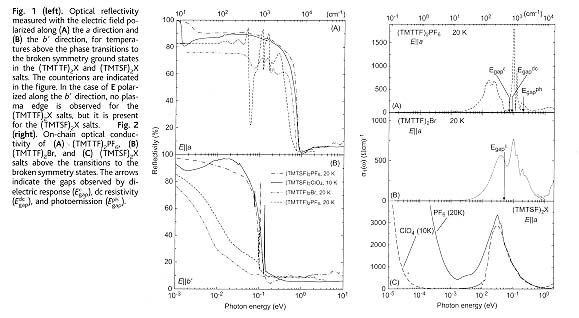
In low dimensional metals, where the ground state is a charge density wave or spin density wave condensate, we have found dramatic deviations from the Drude response in the metallic state at temperatures above the phase transitions. For materials with a CDW ground state, the experiments were conducted in the regime where one-dimensional fluctuations are essential. They give clear evidence for important deviations from conventional metallic behavior in the fluctuating region, below TMF the mean field transition temperature (the materials order well below TMF). The frequency dependence of the conductivity in the direction parallel to the chains is characterized by a pseudogap which develops below TMF, and also by a narrow excitation at low frequencies. Although the fluctuation regime exhibits a reduced electronic density of states at the Fermi energy (as seen in the spin susceptibility), collective contributions to the charge transport lead to an enhanced conductivity at low frequencies. This demonstrates that thestate is clearly non-Fermi liquid as the low lying excitations do not have a simple Fermi character.
The electrodynamic response of the metallic state of three highly anisotropic organic conductors based on the molecule tetramethyltetraselenofulvalene (TMTSF)2X, with the counterions X = PF6, AsF6, ClO4 was extensively examined. In these materials, electron-electron interactions lead to a spin density wave (SDW) state at low temperatures. For all cases, we find dramatic deviations from a simple Drude response in the "metallic" state. The optical conductivity has two features: a narrow mode at zero frequency, with a small spectral weight, and a mode centered around 200 cm-1, with nearly all of the spectral weight expected for the relevant number of carriers and single particle bandmass. We suggested that these features are characteristic of a nearly one-dimensional (1D) half-filled or quarter-filled band with Coulomb correlations. The frequency dependence of the optical conductivity s 1(w ) is in agreement with calculations based on a weakly interacting Luttinger liquid, which is different from what is expected for an uncorrelated 1D semiconductor. We have also measured the single particle gap associated with the spin density wave ground state in the material (TMTSF)2PF6. The optical gap can be described by the formalism originally developed for the BCS superconducting gap, with the difference ascribed to the different coherence factors associated with the two different ground states.
Images
SELECTED REFERENCES
Electron-electron interctions lead to a renormalized Fermi-liquid state at low temperatures which can be characterized by a renormalized effective mass
We have explored the electrodynamics of the coherent state of the so-called heavy fermion (HF) materials, and have found that a narrow many-body resonance appears at low temperatures with a spectral weight which leads to a large dynamical mass. By combining millimeter wave and optical results, we explored the progressive development of the renormalized Drude response and explored the relationship between the electrodynamics and thermodynamics of heavy fermions. Our experiments on the magnetic states of these materials led to the identification of two classes of heavy fermion magnets: those with no gap in the charge excitation spectrum, and those with a partial gap at the Fermi surface (the latter is suggestive of a spin density wave state).
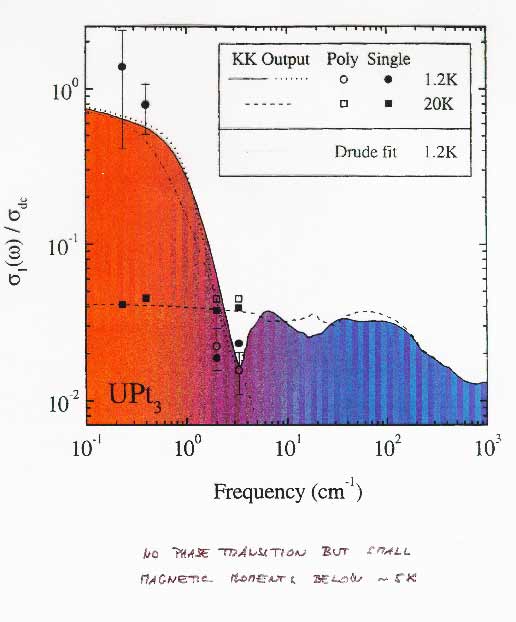
Our experiments on the archetype
heavy fermion metal UPt3 may have far reaching implications. In this
material, we have observed a pseudogap at low temperatures together with a renormalized
low frequency Drude response. The gap energy in units of  ,
is comparable to the temperature where the magnetic correlations develop, 5
K, and the pseudogap progressively disappears above this temperature. The observation
suggests that, in this material ( and possibly in other compounds where electron-electron
correlations are important), the development of a coherent Fermi liquid state
is followed, upon further decrease of the temperature, by a state where the
excitations do not have a simple gapless character, a feature incompatible with
a one-component FL state.
,
is comparable to the temperature where the magnetic correlations develop, 5
K, and the pseudogap progressively disappears above this temperature. The observation
suggests that, in this material ( and possibly in other compounds where electron-electron
correlations are important), the development of a coherent Fermi liquid state
is followed, upon further decrease of the temperature, by a state where the
excitations do not have a simple gapless character, a feature incompatible with
a one-component FL state.
Images
|
KK Output |
Heavy Fermions Selected References
3. ELECTRON GLASSES AND QUANTUM PHASE TRANSITIONS
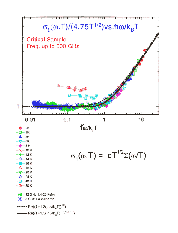
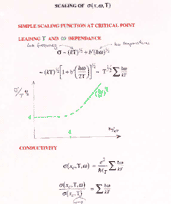
Disorder may lead in three dimension to localized electron states, and to a metal insulator transition with increasing disorder. This transition can be described, under certain circumstances, as a zero temperature, quantum phase transition. We have also reexamined the electrodynamics of metals where disorder drives the system into an insulating state; this transition is regarded as a zero temperature quantum phase transition (QPT). Millimeter-wave transmission measurements have been performed in amorphous niobium-silicon alloy samples where the DC conductivity follows the critical temperature dependence s dc µ T 1/2. The real part of the conductivity is obtained at eight frequencies in the range 87-1040 GHz for temperatures 2.6K and above. In the quantum regime (hw > kBT) the real part of the high-frequency conductivity has a power-law frequency dependence Re s (w ) µ w 1/2. For temperatures 16K and below the data exhibits temperature-frequency scaling predicted by theories of dynamics near quantum-critical points.
IMAGES
|
Quantum phase transition |
Critical Sample Freq. up to 500 GHz |
Scaling Function at Critical Point |
QUANTUM PHASE TRANSITIONS SELECTED REFERENCES
1. H-L Lee, J.P. Carini, D.V. Baxter, and G. Grüner, "Temperature-Frequency Scaling in Amorphous Niobium-Silicon near the Metal-Insulator Transition," Physical Review Letters, 80, 4261 (1998)
2. H.-L. Lee, J.P. Carini, D.V. Baxter, W. Henderson and G. Grüner, "Quantum-critical scaling for a metal-insulator transition", Science 287, 633 (2000)
Research | Techniques | Applications | Teaching | Publications | Collaborators