


Next: About this document
Next: About this document
D. Subbarao, S. Bhaskar
 , H.Singh
and R. Uma
, H.Singh
and R. Uma
Indian Institute of Technology (Delhi)
Cylindrical laser beam propagation is best modelled for fast computation using a spectral method based on Hankel transform technique.A split step Hankel transform based beam propagation algorithm for a nonlinear plasma and its computational implimentation are discussed in the paper.
Many analytical techniques of solving self-focusing in a plasma have been derived by approximation of the partial differential equation of the beam[1-4]. These approximations try to reduce the partial differential equations to a suitable set of ordinary differential equations, each in a single dimension, because exact solutions can not be worked out in terms of the inverse transform technique [3,5] always. The beam in its direction of propagation evolves slowly while in the transverse direction, the same cannot be assumed.
A convenient way of taking into account the faster transverse variations in general is to use methods based on representation of the beam in convenient orthogonal spaces [4,6-9].The choice of the orthogonal transformation space depends on the symmetries and hence the inherent group-theoretical structure and nature of the partial differential equation involved. A popular choice which works reasonably almost always is angular spectrum representation in terms of Fourier transformation of the beam [2,4,7,10] and is the basis of many a computational scheme known as the beam propagation or FFT-based methods. Such simple angular spectrum representations, however, are not always the best choice and prompt one to choose other transformation spaces such as the Hermite-Gauss transformation or the Laguere-Gauss transformation for some beams [1,8,11-13]. A complete scheme of analysis is possible using any of these non-Fourier transformations as outlined in Ref.[14] but are not very convenient computationally because there are no fast techniques like the FFT for such transformations. These methods are often superior to finite difference methods to solve the Nonlinear Shcrodinger equation (see Taha and Ablowitz [15], and Weidman and Herbst [16] for details). The so-called beam propagation methods based on FFT angular spectrum expansions of a soliton [14-23] are typcal of such methods.Analytical methods mentioned above particularly Refs.[4,8-13] have shown that aberrational effects are better accounted for using such transformed spaces and could seem dramatic in terms of the improvements of the results .
In this paper an attempt has been made to solve the beam equation using beam propagation computational methods for the cylindrical geometry . Our paper is based on the cylindrical laser beam propagation formulation for a nonlinear plasma in terms of Hankel transformations by Subbarao and colleagues [4,8,10] adapting fast Hankel transformation techniques due to Siegman [24] and Lax et. al. [19] and making them more suitable for high performance computing environments. Group theoretical representations and and their use in improvements of the results are discussed as one goes along.
The representaion of beam electric field
 in cylindrical coordinates is made up of two parts. Firstly the Fourier
mode representation in the periodic
in cylindrical coordinates is made up of two parts. Firstly the Fourier
mode representation in the periodic
 coordinate is truncated by M modes relavant to the azimuthal details
expected and secondly the radial analysis is carried out using by Hankel
transformation . As a result of moving over to the momentum space defined
by the Hankel transformation, the Bessel operator
coordinate is truncated by M modes relavant to the azimuthal details
expected and secondly the radial analysis is carried out using by Hankel
transformation . As a result of moving over to the momentum space defined
by the Hankel transformation, the Bessel operator
 in the linear part of the radial electric field wave equation would introduce
simply a constant multiplication factor , its eigenvalue
in the linear part of the radial electric field wave equation would introduce
simply a constant multiplication factor , its eigenvalue
 being independent of the mode of the Bessel's function taken. The operator
that arises from the nonlinear portion of the dielectric function of the
plasma,
being independent of the mode of the Bessel's function taken. The operator
that arises from the nonlinear portion of the dielectric function of the
plasma,
 , is
, is
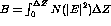 and appears as a sum with the above noncommuting linear operator in an
exponent that desctribes the steady state beam envelope evolution of the
scalar wave.The split-step method used by us for beam propagation is based
on this exponential operator being approximated using the Baker-Hausdroff
formula of Lie groups ( Tappert et.al.[17]) to split it into two separate
consecutive operators.The Fast Hankel Transformation (FHT) based split step
operator
and appears as a sum with the above noncommuting linear operator in an
exponent that desctribes the steady state beam envelope evolution of the
scalar wave.The split-step method used by us for beam propagation is based
on this exponential operator being approximated using the Baker-Hausdroff
formula of Lie groups ( Tappert et.al.[17]) to split it into two separate
consecutive operators.The Fast Hankel Transformation (FHT) based split step
operator
 can, then be defined through the equation
 on the
 azimuthal mode which can explicitly be written as:

Finally,
 advances the electric field along propagation direction by one step. Group
theoretical representation of the paraxial beam is of particular interest
in this paper. The FHT procedure is equivalent to the two dimensional Fourier
transformation which could be used directly. Depending on the symmetry of
the beam, the present method is, however, expected to save computational
time.
advances the electric field along propagation direction by one step. Group
theoretical representation of the paraxial beam is of particular interest
in this paper. The FHT procedure is equivalent to the two dimensional Fourier
transformation which could be used directly. Depending on the symmetry of
the beam, the present method is, however, expected to save computational
time.
Address of the Principal Author: Fusion Studies Program, Plasma Sc. and Tech.
Group, Centre for Energy Studies, Indian Institute of Technology (Delhi)
New Delhi 110 016. INDIA. Fax: 91-11-6862037,6855227 ; Telephone: 91-11-(6861977
to 6861986) Ext.5035,8801. e-mail: dsr@ces.iitd.ernet.in
**The author H.Singh is at present with the Computer Applications R&D
group of NIIT,Delhi and the author S.Bhaskar is at present with Motorola,
Bangalore.
Acknowledgements: This work has been supported by the CSIR Research
Scheme No.03(0815)/ 97/ EMR-II, India.
References
1. Amnon Yariv in `Optical Electronics,4th. Edition' (Harcourt Brace Jovanovich College Publishers, Fort Worth, 1991) Chapt.2,p.35.
2. S.A. Akhamanov, A.P. Sukhorukov, and R.V. Kokholov, in `Laser Handbook' ed. F.T.Arechi and E.O.Schulz Dubois (North-Holand, Amsterdam, 1974), Vol. II, p. 1151.
3. G.B. Witham, `Linear and Nonlinear Waves' Wiley Interscience, New York, 1974, p. 540
4. D. Subbarao and M.S. Sodha, `Self-focusing - A Perspective' in, Contemprory plasma Physics ed. M.S. Sodha, D.P. Tewari and D. Subbarao, p 249-304 (Mcmillan India Ltd. New Delhi 1984).
5. S. Novikov, S.V. Makhankov, C.P. Pitaevskii, and V.E. Zakharov, `Theory of Solitons' (Consultants Bureau, New York, 1984).
6. J.A. Stratton. `Electromagnetic theory' (McGraw Hill, New York 1972).
7. J.W. Goodman, `Introduction to Fourier Optics' (McGraw-Hill, New York, 1968).
8. D. Subbarao and M.S. Sodha `Theory of paraxial self-focusing' J. Appl. Phys. 50(7) 4604 (1979).
9. D. Subbarao, R. Uma and A.K. Ghatak, `Wave optical theory for self-focusing of laser beams in plasmas' Laser and Particle Beams (1983), vol. 1, part 4, p. 367-377.
10. D. Subbarao Ph.D thesis `Nonlinear Electromagnetic Wave Interactions with Plasmas', IIT Delhi 1981 (Unpublished).
11. R. Uma Ph.D. thesis `Ponderomotive Effects in Nonlinear Wave-Plasma Interactions and role of Chaos', IIT Delhi 1988 (Unpublished).
12. D. Subbarao, R. Uma and H. Singh Report:IITD/CES/FUS/1996-2 on `ABCD Laws and Nonlinear Dynamics of Self-focusing.' (Unpublished).
13. H. Singh Ph.D. thesis `Nonlinear Dynamics of Self-focusing and Soliton' , IIT Delhi 1996 (Unpublished).
14. H. Singh,D. Subbarao and R. Uma, `Parallelizable scheme for laser beam and soliton propagation in linear and nonlinear media.' Proceedings of International Conference on High Performance Computing (Tata McGraw Hill, New Delhi, 1996) pp.169-174.
15. T.R. Taha and M.J. Ablowitz, J. Comp. Phys. 55, p. 203-230 (1984).
16. J.A.C. Weidman, and B.M. Herbst, `Split-Step methods for the solution of the nonlinear Schrodinger Equation.' SIAM vol.23 No.1 p. 485-507 (1986).
17. R.H. Hardin and F.D. Tappert, `Application of the Split-step Fourier Method to the Numerical Solution of Nonlinear and Variable Coefficient Wave Equation' SIAM 15, 423 (1973).
18. A. Hasegawa and F. Tappert, `Transmission of stationary nonlinear optical pulses in dispersive dielectric fibre : Normal dispersion' Appl. Phys. Lett 23 142 (1973); `Anamolous dispersion.' Appl. Phys. Lett. 23 171 (1973).
19.M. Lax, J.H. Batteh, and G.P. Agrawal, `Channeling of intense electromagnetic beam.' J Appl. Phys. 52(1) 109 (1981).
20. Alan C. Newell and Jerome V. Moloney , `Nonlinear Optics' (Addison Wesley,Redwood City, 1992)
21. G.P. Agarwal ,`Nonlinear Fibre Optics' (Acadamic Press,Inc. Boston 1989).
22. R.A. Fisher and W. Bischel, Appl. Phys. Lett. 23 660 (1973).
23. A. Korpel, K.E. Lonngren, P.P. Banerjee, H. K. Sim and M. R. Chatterjee `Split-step-type angular plane-wave spectrum method for the study of self-refractive effects in nonlinear wave propagation.' J. Opt. Soc. Am. B Vol. 3, No. 6 885 (1986).
24. A. E. Siegman, `Quasi-fast Hankel transform.' Optics letters 1 13 (1977).
D. Subbarao