Home|
Syllabus|
Notes|
Assignments
Typical Emissive Probe Traces
Plasma Physics Laboratory
R. L. Stenzel, Winter '97
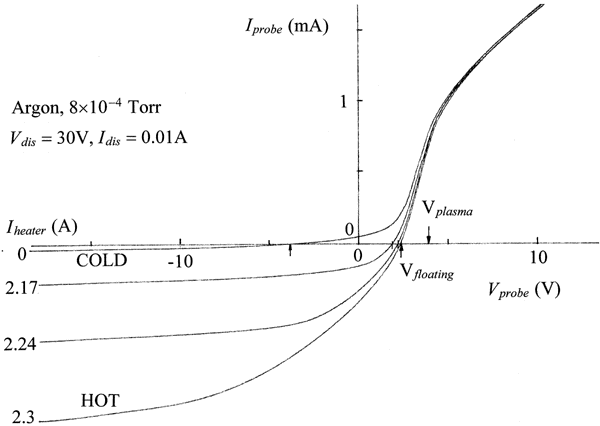
Typical I-V characteristics of an emissive probe.
Here are some of the basic features of an emissive probe:
- With increasing heater voltage a large electron
emission current is observed when the probe bias is below
the plasma potential.
- The floating potential, defined as the voltage at
zero probe current, shifts toward the plasma potential.
The larger the emission current, the closer the emissive
probe floats to the plasma potential.
- The plasma potential can be approximately obtained from the
open-loop voltage of an emissive probe. This method is simpler than
finding the knee of a single probe. The plasma potential can be measured
instantaneously. Since the emissive probe draws no current it perturbs
the plasma much less than the single probe drawing electron saturation
current. Disadvantages are the required floating heater supply and the
fact that one does not truely measure the exact plasma potential.
- The slope of the I-V characteristics is
inversely proportional to a differential
resistance dV/dI. Considering the probe as a voltage source,
a low internal resistance minimizes measurement errors with
a voltmeter of finite load resistance. In time-dependent measurements,
the probe's internal resistance and the external circuit
capacitance determine the time resolution of the probe.
- The emissive probe is primarily used for electric field
measurements. The electric field in a plasma is defined by the
gradient in the plasma potential, E=-gradVplasma.
Gradients in the floating potential of a cold probe are very
sensitive to gradients in the temperature and primary electrons,
hence too ambiguous for electric field measurements. In order to
measure an electric field instantaneously, i.e. without moving
the probe, one uses a double emissive probe and measures its
open-loop voltage.
Home|
Syllabus|
Notes|
Assignments
Page maintained by
R. L. Stenzel and/or
J. M. Urrutia
Copyright © 1997, The Regents of the University of California. All Rights Reserved.
Last Update: 5 March 1997
