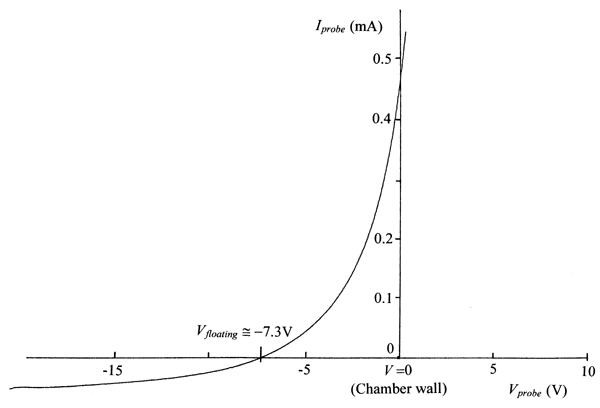
Single Langmuir probe trace in the vicinity of the floating potential.
Home| Syllabus| Notes| Assignments
This region is useful to determine the floating potential and the tail electron temperature.
Only in a Maxwellian plasma one can obtain the plasma potential from the floating potential via the relation Vp=Vf + (kT/e)ln(Iesat/Iisat). Then, from the extrapolated ion current at the plasma potential one can also obtain the density, ne=Iisat/A e sqrt(kT/mi).
The presence of energetic primary electrons in a discharge plasma results in a higher tail electron "temperature" and a more negative floating potential than expected on the basis of the colder bulk electrons. Hence, caution must be applied in inferring plasma parameters from this part of the I-V curve.
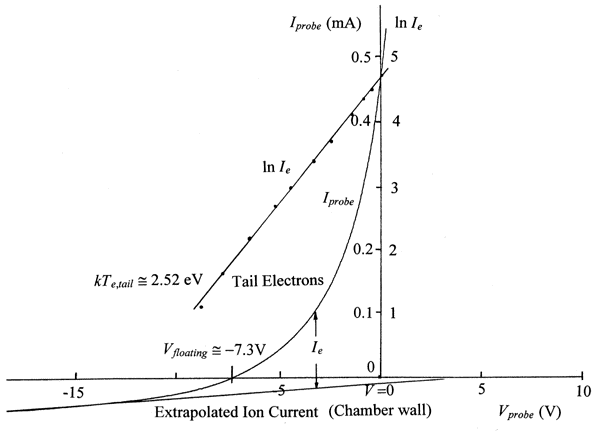
As in the earlier case, one first subtracts the linearly extrapolated ion current from the total current so as to obtain the electron current.
Then, the electron current is plotted on a logarithmic scale and a straight-line fit is made. The voltage difference for a change of one on the vertical scale (lnI) yields the electron temperature. A value of kTe=2.52eV is found which is larger than the bulk electron temperature of 1.47eV.
For kT=2.52eV the plasma potential should be at Vp=Vf+kT/e[ln sqrt(mi/me)]=-7.3+2.52 ln271=6.8V. However, the measured plasma potential is only 2.8V. This example shows influence of the primary electrons on the data analysis.
Home| Syllabus| Notes| Assignments