 National
Science Foundation
National
Science Foundation
National
Science Foundation
|
Following information to be added when NSF grant awarded
|
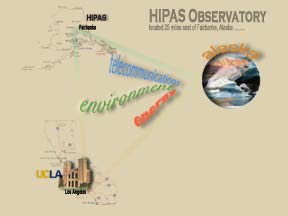
REU Site for Environmental Research in Alaska date: Submitted to NSF - 10.01 Proposed Project Summary This REU site is to provide opportunities for undergraduates to conduct outdoor experiments on the environment using facilities in UCLA’s HIPAS Observatory. A number of students have expressed interest in the application of physical principles to understand and to measure the environmental parameters around them. The theme is to introduce students to the problems in the environment and show how they can find solutions using physics and chemistry. The specific environment is the atmosphere in the Arctic region. Our planet earth can be considered as being surrounded by different “mantles” or “layers”. The outermost is the ionosphere, which connects to the magnetosphere. The lower atmosphere contains a sodium layer and noctilucent clouds. Going still lower the stratosphere contains the ozone layer. All these layers can be probed or altered by electromagnetic waves, some at HF frequencies and others at laser frequencies. The objective then is to introduce the students to methods of measurements of the spatial and temporal variations of these mantles the ionosphere, the metallic layer, the noctilucent cloud layer and the ozone layer. The impact on the student will be to learn about the outdoor atmosphere and to learn how to collect data using the various instruments, such as the digital ionosonde, the Doppler radar, the optical spectrometer, the laser and the focusing dish. They will learn about the program LabView for control and analysis. They will use the program MATLAB to plot the data. They will also learn about plasma physics, both experimental and theoretical, using well-tested textbooks. Most important of all they will acquire hands-on experience. Today’s undergrad is strong in computer skills but generally weak in hardware systems. As a result there is a lack of technical persons in all areas where devices or equipment have to be fabricated. They will learn how to combine theory, laboratory experiments, computer modeling and outdoor experiments together to treat one or several particular topics. Students
accepted will be sophomore to seniors in small Alaskan or other colleges
which do not have extensive research laboratories but have a keen interest
in the environment. They should have some computer skills in Fortran,
C+ and MATLAB. We want enthusiastic, creative, resourceful students, preferably
with some outdoor experience. Applicants will be judged holistically and
not just on grade point average. The host institution is the University of California, Los Angeles. The Principal Investigator is Professor Alfred Wong. Support will be provided by Dr. Joe Kan of the University of Alaska, Fairbanks, Geophysical Institute, and by Dr. Mike Kelley of Cornell University. The major field of study is environmental physics. |