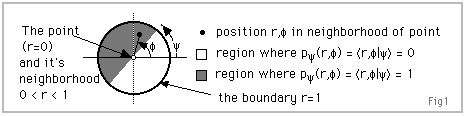

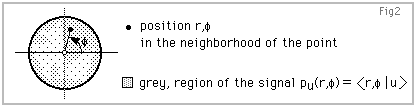

 >". If there exists one value of (say
  ) where the patterns match, then |u> is edgelike. A formal statement of the task may be written

 for each of the -values) to any given unknown display, pu(r,
 ), and seeing whether they are equal.
Lenz shows how this impossible task may be made possible. He recasts the task into an algorithm suitable for practical computation. His statement is
), and seeing whether they are equal.
Lenz shows how this impossible task may be made possible. He recasts the task into an algorithm suitable for practical computation. His statement is

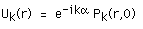 .
In the language of Dirac bra-kets this same result is
.
In the language of Dirac bra-kets this same result is

 is the 1-D irreducible representation with symmetry label k for the group member
  . And
. And
 > is a unitary transformation matrix element connecting the -basis (the scrutiny basis) to the k-basis (irreducible representation basis).
In the present case of the group SO(2)
> is a unitary transformation matrix element connecting the -basis (the scrutiny basis) to the k-basis (irreducible representation basis).
In the present case of the group SO(2)


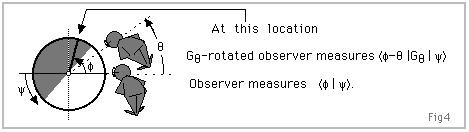
2. Idea:  = the observer rotation angle can affect (the perceived edge angle) and can affect , the position location angle coordinate. Let mean "rotate the observer by the angle ". The are the observer's group of altered scrutinies. The observer sees basis states |> in the basis <|. What state he perceives depends upon his orientation. As is evident from the figure:

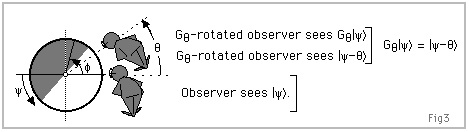 > is generated by the rotation group SO(2) from a single prototype |=0>.

Together all the |> make up an invariant space with respect to the .
affects the position basis is governed by intrinsic sameness against rotation. What the observer measures at the location is exactly the same as what the rotated observer measures at - so

 > we write
 and are both in spaces invariant to the group .
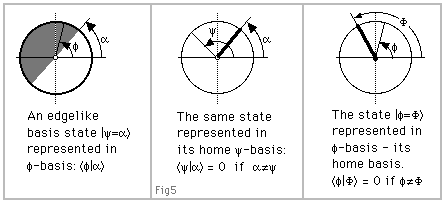 and are in different Hilbert Spaces!
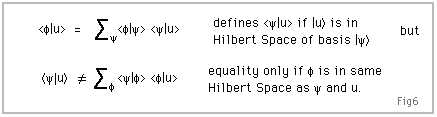 =
= > we may build matrix representations of . These consist of all matrices with elements <||>.
 |
 is one of the k,

 > to states in the basis |k> are derived by applying (3.2) to a state, |k>, and using (5.1) and (5.2).

 >. Having <|k> gives us the means to do it.
 and k mark bases in the same Hilbert Space.
7. In Dirac bra-kets the task of finding "whether the grey pattern is edgelike" can be succinctly put as
and k mark bases in the same Hilbert Space.
7. In Dirac bra-kets the task of finding "whether the grey pattern is edgelike" can be succinctly put as
 -basis. But if the states are the same in the basis- they must be so in any basis of the same Hilbert space. So we may apply (B) in the symmetry basis <k|.


December 1997
Marvin Chester
email: chester@physics.ucla.edu
© m chester 1997 Occidental CA