|
Professor, Physics & Astronomy, UCLA Senior Scientist, Kavli IPMU, U. of Tokyo, Japan Office:

4-915, PAB (click here for a map)
Calendar
(free/busy times)
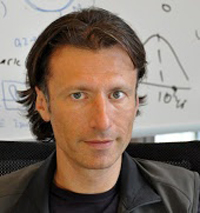
Professor Kusenko received his undergraduate and graduate
education at Moscow
State
University and YITP, Stony Brook,
respectively. He held positions at University of Pennsylvania
and at CERN Theory Division
prior to joining UCLA. Professor Kusenko is a
Fellow of American
Physical Society and an active member of Aspen Center for Physics.
Seminars
this
week TEP group |
Theoretical
Elementary Particle Physics and Astrophysics Research highlights Cosmic Connections: from cosmic rays to gamma rays, to cosmic backgrounds and intergalactic magnetic fields. Supermassive black holes in the centers of distant galaxies can swallow large amounts of gas and stellar matter. Part of the energy is released in the form of a powerful jet which emits high-energy cosmic rays and gamma rays. The highest energy gamma rays cannot travel very far because they lose energy in interactions with starlight and infrared light re-emitted by dust. Yet, some very energetic gamma rays have been observed from some very distant objects. This created a puzzle, whose resolution pointed to a possible contributions of cosmic rays. Now there is a growing evidence that gamma rays arriving from distant sources (z>0.15) did not originate at the source, but were produced in the cosmic ray interactions along the line of sight. This surprising connection between cosmic rays and gamma rays resolves several puzzles, proves that cosmic rays of the highest energies are, indeed, produced in active galactic nuclei, and it opens some new ways to measure extragalactic background light, as well as intergalactic magnetic fields, which permeate deep space between galaxies, possibly, since the time of the Big Bang. Read research papers in ApJ,
ApJ Letters, AP, Phys. Rev. Lett. Neutrinos
Dark matter: sterile
neutrinos, astrophysical hints, ongoing search.
Most of the matter in the universe is dark
matter, which is not made of ordinary atoms. The identity of dark
matter particles remains a puzzle. A well-motivated candidate for such
a particle is the right-handed or sterile
neutrino. This idea is
supported by compelling theoretical arguments and by intriguing astrophysical
hints.
Read about cosmic accelerators in UCLA
News or in CERN
Courier (2010), and Supersymmetric Q-balls are non-topological solitons that
owe their stability to a
conservation of some global charge. Baryonic
Q-balls appear in every
supersymmetric extension of the Standard Model. If
supersymmetry exists, stable Q-balls could be copiously produced at the
end of inflation and may now exist
as a form of dark matter
[read a research paper or a review
article in Rev.
Mod. Phys.]. Baryogenesis. Although every particle has its antiparticle, there is no antimatter in the observed universe. The process in which the matter-antimatter asymmetry was produced in the early universe, called baryogenesis, remains a mystery. An appealing scenario is the Affleck-Dine baryogenesis, which can generate both ordinary matter and dark matter [read a review article in Rev. Mod. Phys.]. |