


An algorithm (`Transmitted-wave' boundary condition) has been developed previously in order to handle the connection of grids having arbitrary resolution. This algorithm allows (as shown on Fig. 2) the transmission of the low-frequency part of a signal without reflections of the high frequency part between two grids having arbitrary resolution. The practical application of this algorithm along the use of the Yee FDTD algorithm is difficult because the `Transmitted-wave' boundary condition is directional (the equation depends on the direction of propagation of a signal along an axis) while the Yee algorithm is not.
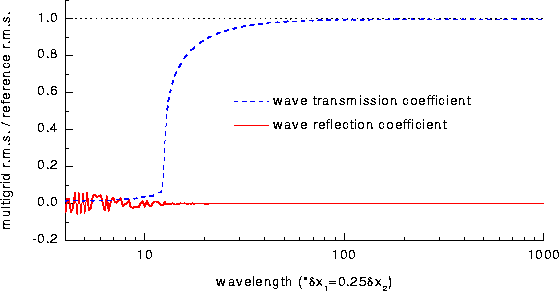
Figure 2: This graph displays the transmission and reflection coefficients for
a wave crossing the boundary between one grid of mesh size  and
a grid having a resolution four times lower (
and
a grid having a resolution four times lower (  ), using the 'Transmitted-wave' boundary condition.
The new FDTD scheme is by construction directional, a distinction on the
direction of propagation along an axis is made by the coupling between the
terms E and  , and it reduces to the 'Transmitted-wave' boundary
condition for a specific set of
, and it reduces to the 'Transmitted-wave' boundary
condition for a specific set of  . Considering the
connection of two grids having for mesh sizes and
. Considering the
connection of two grids having for mesh sizes and  and defining
  and
and  , then the coefficients of the connecting equation

are defined as
